



Key Takeaways
- A single release date built on average velocity promises 100% certainty in a 50% world, which is why so many dates are really just hopeful guesses.
- Monte Carlo flow forecasting runs thousands of simulated futures from your real historical throughput and returns a range of dates, each with a probability, instead of one number.
- The three markers to know are P50 (a coin-flip median for internal milestones), P85 (the defensible date to commit externally), and P95 (the worst-case insurance date).
- Velocity is only half the story: future capacity matters too, so three people on vacation next month makes historical velocity a lie unless you plan around availability.
- Release Management, Roadmaps, Portfolio PPM & Timeline combines historical flow with real capacity, letting you adjust for holidays and resource changes and see epics down to subtasks on one screen.
Let’s be honest for a second, closer than a stand-up update, but less awkward than a late-night sprint planning session. When you tell a stakeholder that your team will ship the new feature on October 15th, are you stating a fact, or are you lighting a candle and whispering a prayer to the gods of software stability?
For most of us, it’s the latter. We look at our average velocity, squint at the backlog, and throw a dart at the calendar. We call it "planning," but without the right data, it’s closer to an optimistic guess. So what, you ask? Well, the "guess" approach leads to burned-out devs, grumpy clients, and a reputation for "Agile" meaning "we'll get there when we get there."
It’s time to trade the prayer beads for a magnifying glass. Welcome to the world of the Truth Detector.
The Great Release Date Lie
Traditional planning relies on a single number: your team's velocity. "We do 40 points a sprint, we have 400 points left, so we’ll be done in 10 sprints."
Remember Grasshopper, oldtimer? The world isn't that linear. Life happens. Bugs crawl out of the woodwork, half the team catches the flu in November, and that "simple" API integration turns into a three-week descent into architectural madness.
When you give a single date, you are promising 100% certainty in a 50% world. That’s not a plan; it’s a setup for failure.
Enter the Truth Detector: Monte Carlo Flow Forecasting
If you want to stop guessing and start knowing, you need Monte Carlo flow forecasting. It sounds like a high-stakes gambling strategy (and in a way, software development is), but it’s actually the most honest mathematical tool in an Agile team's belt.
Instead of looking at a single average, a Monte Carlo simulation takes your real, historical throughput and runs thousands of simulated futures. It asks: "What if next week is slow? What if the week after is a productivity explosion? What if everything goes slightly sideways?"
By simulating these thousands of "what-ifs," it gives you a range of dates, each with a specific probability. This is where we replace "I hope" with "The math says."
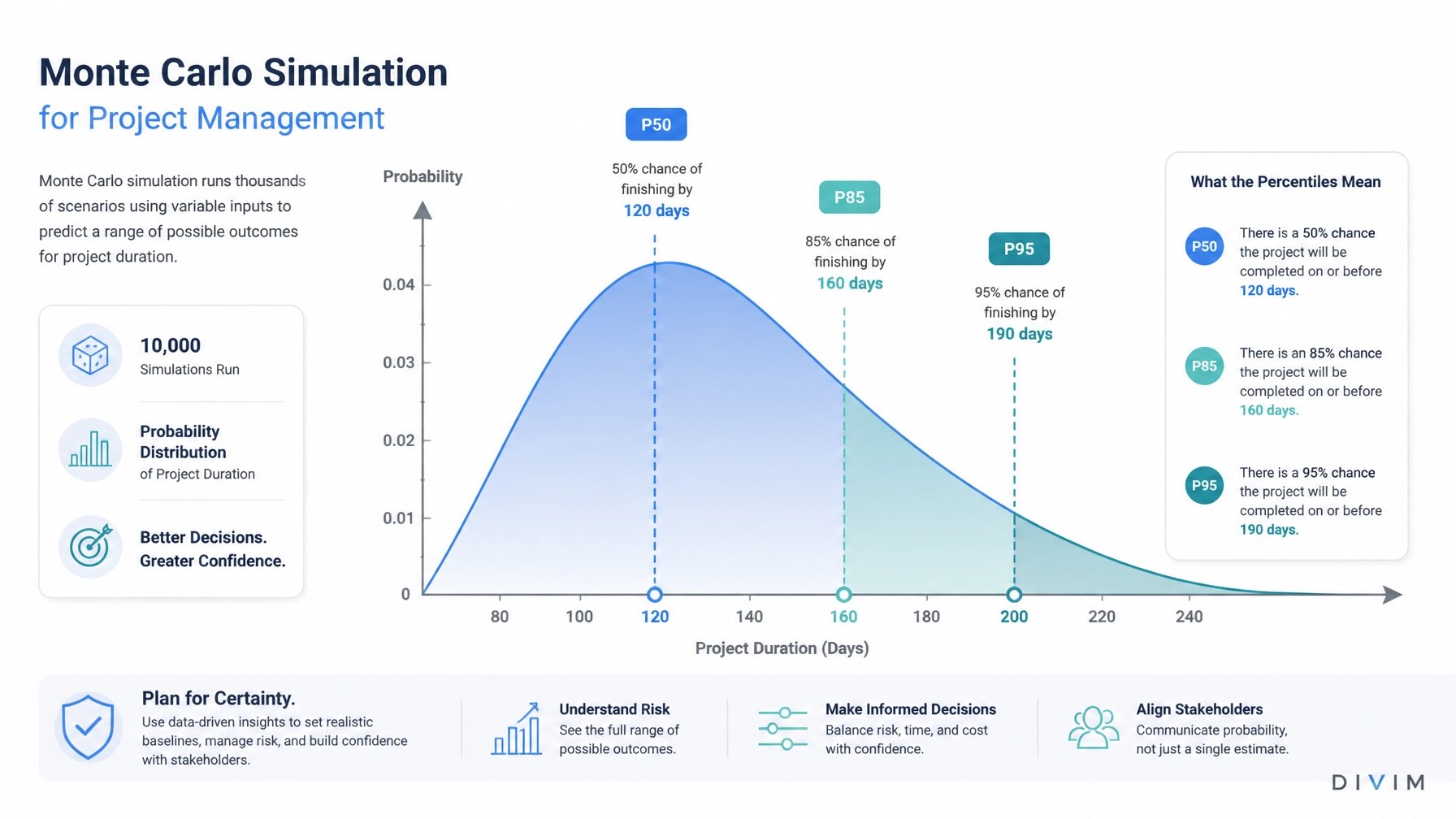
The Magic Numbers: P50, P85, and P95
Efficiency-Obsessed Workaholics Rejoice! We don't have to deal with "vibes" anymore. We have percentiles. When you use the Truth Detector, you’ll see three key markers:
- P50 (The Optimist's Median): There is a 50% chance you’ll finish by this date. It’s essentially a coin flip. Use this for internal milestones, but for the love of all things holy, don’t promise this to your CEO.
- P85 (The Professional’s Commitment): There is an 85% chance you’ll finish on or before this date. Only 15% of the simulated "futures" were worse than this. This is the gold standard for external commitments. It’s realistic, defensible, and accounts for most of life's "glitches."
- P95 (The "Insurance Policy"): A 95% certainty. Only the most catastrophic scenarios (or a month-long office-wide Wi-Fi outage) result in a later date. This is your "worst-case scenario" marker.
Why Velocity is Only Half the Story
While Monte Carlo is great for the "when," it only works if you understand your team's current engine. This is where many teams stumble. They look at past velocity but ignore future capacity.
If you have three people on vacation next month, your historical velocity is a lie. This is why we built Scrum Agile Sprint Planning with Capacity Planning for Jira. It allows you to see your team's actual availability, including days off and individual allocation, directly alongside your sprint data.
Fixing It with Release Planning for Jira Cloud
At Divim, we believe that software management shouldn't feel like a dark art. Our tools are designed to bring that "Truth Detector" energy to your Jira instance.
With Release Planning for Jira Cloud, you can stop jumping between spreadsheets and Jira boards. You can:
- Visualize Multi-Sprint Capacity: Adjust for holidays and resource changes before they wreck your timeline.
- See the Full Picture: From Epics down to subtasks, see the aggregate results of your team's work on a single screen.
- Bridge the Gap: Combine your historical flow with real-world capacity to give stakeholders a date that actually sticks.
(Well, let’s ignore this month’s glitch where Dave accidentally deleted the staging environment: even Monte Carlo can't account for Dave.)
Want the feature-by-feature breakdown, including what’s in Standard vs Advanced? See the Advanced Release Planning for Jira features and plans comparison.

Stop Praying, Start Planning
The goal isn't just to "be fast." It's to be predictable.
Predictability is what earns the trust of your stakeholders. It’s what lets your developers go home on a Friday afternoon without the looming shadow of a missed deadline. By using mathematical certainty over gut feelings, you aren't just managing a project; you're leading a professional, high-trust team.
So, the next time someone asks, "When will it be ready?", don't look at the ceiling for inspiration. Look at the data.
Head today to the Atlassian Marketplace and try our apps for free. Your future self (and your stakeholders) will thank you.

About Divim
Divim is dedicated to making Agile work for the enterprise. We build tools for Jira that simplify complex processes, from capacity planning to release management.
Copyright © 2026 Divim, Inc. All rights reserved.
{“@type”:”BlogPosting”,”image”:”https://cdn.marblism.com/nZ5XqEJwnE2.webp”,”author”:{“name”:”Divim”,”@type”:”Organization”},”@context”:”https://schema.org”,”headline”:”The Truth Detector: Why Your Release Date is a Prayer (and How to Fix It)”,”publisher”:{“logo”:{“url”:”https://www.divim.io/”,”@type”:”ImageObject”},”name”:”Divim”,”@type”:”Organization”},”articleBody”:”Traditional software planning often relies on optimistic guesses. This post introduces the concept of ‘The Truth Detector’—Monte Carlo flow forecasting—which uses historical Jira data to run thousands of simulations. By understanding percentiles like P85, teams can move away from ‘prayers’ and toward mathematical certainty in their release planning. The article also highlights the importance of capacity planning using Divim’s specialized Jira tools.”,”description”:”Learn why traditional Agile planning is often just ‘praying’ and how Monte Carlo flow forecasting (P50, P85, P95) provides mathematical certainty for Jira release dates.”,”datePublished”:”2026-05-19″}
