



Key Takeaways
- Real predictability is about probability, not a single number: measure cycle time as p50 (a coin flip), p85 (the gold standard for internal commitments), and p95 (for external or high-stakes dates).
- If a team’s p85 cycle time is 10 days and they promise a feature in 5, the data says they are dreaming.
- The Coefficient of Variation tells you whether the timing data can be trusted: a low CV under 0.4 signals a stable process, while a high CV over 0.8 means the release plan is fiction.
- You should not commit to a hard deadline until a high-CV workflow has been stabilized.
- Release Management, Roadmaps, Portfolio PPM & Timeline brings percentiles and cross-project releases into one dashboard, tracking progress against actual historical performance instead of wishful thinking.

"How long will it take?"
It’s the question that has launched a thousand late-night sprint planning sessions and caused more than a few nervous twitches in Product Managers everywhere. Usually, the answer is a shrug, a "trust me, bro," or a highly optimistic date that expires faster than milk in the sun.
But here at Divim, we’re a bit obsessed with efficiency. We don't think release planning should feel like reading tea leaves. That’s why we’re diving deep into Predictability Scores, the data-driven way to know exactly which teams are ready for high-stakes commitments and which ones are still living in the "wild west" of cycle times.
The Confidence Game: p50, p85, and p95
If you ask a team for an estimate and they give you a single number, they’re lying to you. (Okay, maybe they just really want to believe it, but the result is the same). Real predictability is about probability.
When we look at cycle time, the time it takes for an issue to go from "In Progress" to "Done", we don't just look at the average. Averages are for people who like being wrong 50% of the time. Instead, we use percentiles:
- p50 (The Optimist): 50% of your tasks finish within this time. It’s the flip of a coin.
- p85 (The Professional): 85% of tasks finish here. This is the gold standard for internal commitments.
- p95 (The "No Way This Fails" Date): 95% of tasks finish here. Use this for your external customers or when your CEO is breathing down your neck.

By tracking these scores in your Agile project management tools, you move from guessing to knowing. If a team’s p85 is 10 days, and they promise a feature in 5, you can politely suggest they’re dreaming.
The Secret Sauce: Coefficient of Variation (CV)
Percentiles tell you how long things take, but the Coefficient of Variation (CV) tells you if you can actually trust that data.
Think of it this way: If Team A always finishes tasks in exactly 5 days, their CV is low. They are predictable. If Team B finishes one task in 1 day and the next in 19, their average is still 10, but their CV is sky-high. They are basically a unicycle on ice, fast one second, crashing the next.

A low CV (under 0.4) means a team has a stable process. A high CV (over 0.8) means your release plan is a work of fiction. So what, you ask? Well, it means you shouldn't commit to a hard deadline until you've stabilized that workflow.
Release Planning for Jira Cloud: No More Spreadsheets
We know what you’re thinking: "Penny, I don't have time to do math in my head while my team is arguing over story points."
We hear you. That’s why we built our Release Management & Roadmaps for Jira. It’s designed to bring all this complexity into one simple, beautiful dashboard. Instead of hunting through three different projects to see if you’re on track, you get a unified view of your cross-project releases.
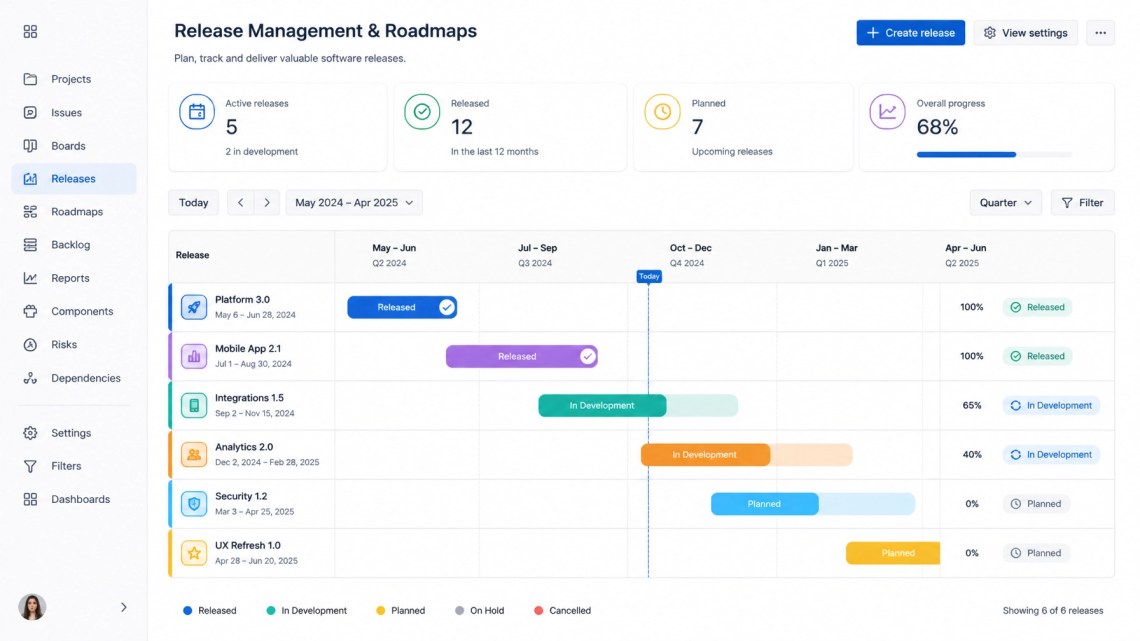
Whether you’re managing a single team or a massive Agile Release Train, our tools help you visualize dependencies and track progress against actual historical performance: not just wishful thinking. Efficiency-obsessed workaholics rejoice!
Why This Matters for Enterprise
Reliability isn't just a "nice to have": it’s a requirement for enterprise-ready teams. When you can show stakeholders a p85 confidence interval rather than a random date, you build a level of trust that "trust me, bro" can never reach.
Our commitment to transparency and security is reflected in everything we do, from our Trust Center to our enterprise-grade support. We believe that better data leads to better software and, ultimately, happier teams who actually get to go home on time.

Ready to stop guessing and start delivering? Head today to the Atlassian Marketplace and try our apps for free. Let’s turn those "maybes" into "done."
About Divim
We build the tools that help modern software teams scale without the chaos. From capacity planning to cross-project release management, we’re here to make Jira work harder so you don’t have to.
© 2026 Divim, Inc. All rights reserved.
{“@type”:”BlogPosting”,”image”:[“https://cdn.marblism.com/mpHioKLF8dX.webp”,”https://cdn.marblism.com/e-F0QgPme8g.webp”,”https://cdn.marblism.com/BwGMm7-L4Fr.webp”,”https://cdn.marblism.com/CkpxICGvsd3.webp”,”https://cdn.marblism.com/6sdI8xwGIDa.webp”],”author”:{“url”:”https://www.divim.io/”,”name”:”Divim”,”@type”:”Organization”},”@context”:”https://schema.org”,”headline”:”Predictability Scores: Knowing Which Teams to Trust for Commitments”,”publisher”:{“logo”:{“url”:”https://www.divim.io/logo.png”,”@type”:”ImageObject”},”name”:”Divim”,”@type”:”Organization”},”description”:”Learn how to use Predictability Scores, p50/p85/p95 confidence intervals, and Coefficient of Variation (CV) to improve your release planning for Jira Cloud.”,”datePublished”:”2026-05-19″,”mainEntityOfPage”:{“@id”:”https://www.divim.io/blog/predictability-scores-jira”,”@type”:”WebPage”}}