



Key Takeaways
- The Wishful Thinking Trap is planning on headcount and hypothetical averages, then watching the date slip the moment someone takes PTO or a public holiday appears.
- Reporting looks in the rear-view mirror, while capacity-aware forecasting flips to active, forward-looking planning based on who is actually available.
- Accurate forecasts blend three variables into the simulation: individual PTO, region-specific public holidays, and headcount changes you can model as a what-if.
- Seeing past velocity, current sprint points, and planned capacity in one view lets a team decline over-commitment with data instead of a guess.
- Divim positions Release Management, Roadmaps, Portfolio PPM & Timeline alongside Enterprise Sprint Automation and Agile Flow Metrics, all aimed at planning clarity.

We’ve all been there. It’s Monday morning, the coffee hasn’t quite kicked in yet, and you’re staring at a Jira roadmap that looks like a work of fiction. According to the chart, your team is a group of tireless, 24/7 productivity machines who never sleep, never get sick, and certainly never take a long weekend in the Hamptons.
Spoiler alert: They aren't. And they do.
At Divim, we’ve spent years watching enterprise teams struggle with the gap between "what the plan says" and "what actually happens." We call this the Wishful Thinking Trap. It’s where you plan based on headcount and hypothetical averages, only to watch your release date slip the moment Brenda from DevOps takes a well-deserved vacation or a public holiday sneaks up on you like a silent ninja.
It’s time to stop reporting on what happened and start forecasting what can happen. Welcome to the world of Capacity-Aware Forecasting.
The Reporting Trap: Why Your Roadmap is Lying to You
Most agile tools are great at telling you what you did last month. "Look!" they exclaim, "Your velocity was 45 points!" That’s nice. We love data. But reporting is essentially looking in the rearview mirror.
So what, you ask? Well, the problem starts when you use that historical average to predict the future without checking the weather. If your average velocity is 45, but next sprint half the team is out for a regional holiday and your lead developer is at a conference, your velocity isn't going to be 45. It’s going to be… well, significantly less.
When you plan with "Wishful Thinking," you’re setting your team up for burnout and your stakeholders up for disappointment. Capacity-aware forecasting is about flipping the script. It’s about moving beyond static reports to active, capacity-based planning.

The Three Pillars of Reality: PTO, Holidays, and Headcount
If you want to forecast with any level of accuracy, you need to blend three critical variables into your simulations. This is where Release Planning for Jira Cloud from Divim becomes your new best friend.
1. The PTO Problem (Personal Time Off)
Your team members are humans (at least until our AI overlords fully take over, but let's ignore this month's glitch). They have lives. They take vacations. In a standard Jira setup, tracking PTO is a nightmare of spreadsheets and "I think he's out next week?" conversations.
Capacity-aware forecasting integrates individual PTO directly into the roadmap. When someone books a week off, the system automatically adjusts the team’s total available hours. No more manual math. No more "Whoops, I forgot about the wedding."
2. The Holiday Ninja
Public holidays vary by region, country, and sometimes even by office floor. If you have a distributed team, managing this manually is a full-time job. A capacity-aware tool knows when the office is closed in Krakow, even if the team in New York is working. It treats holidays as a hard constraint, shrinking the available "bucket" of work for that specific period.
3. Headcount Simulations
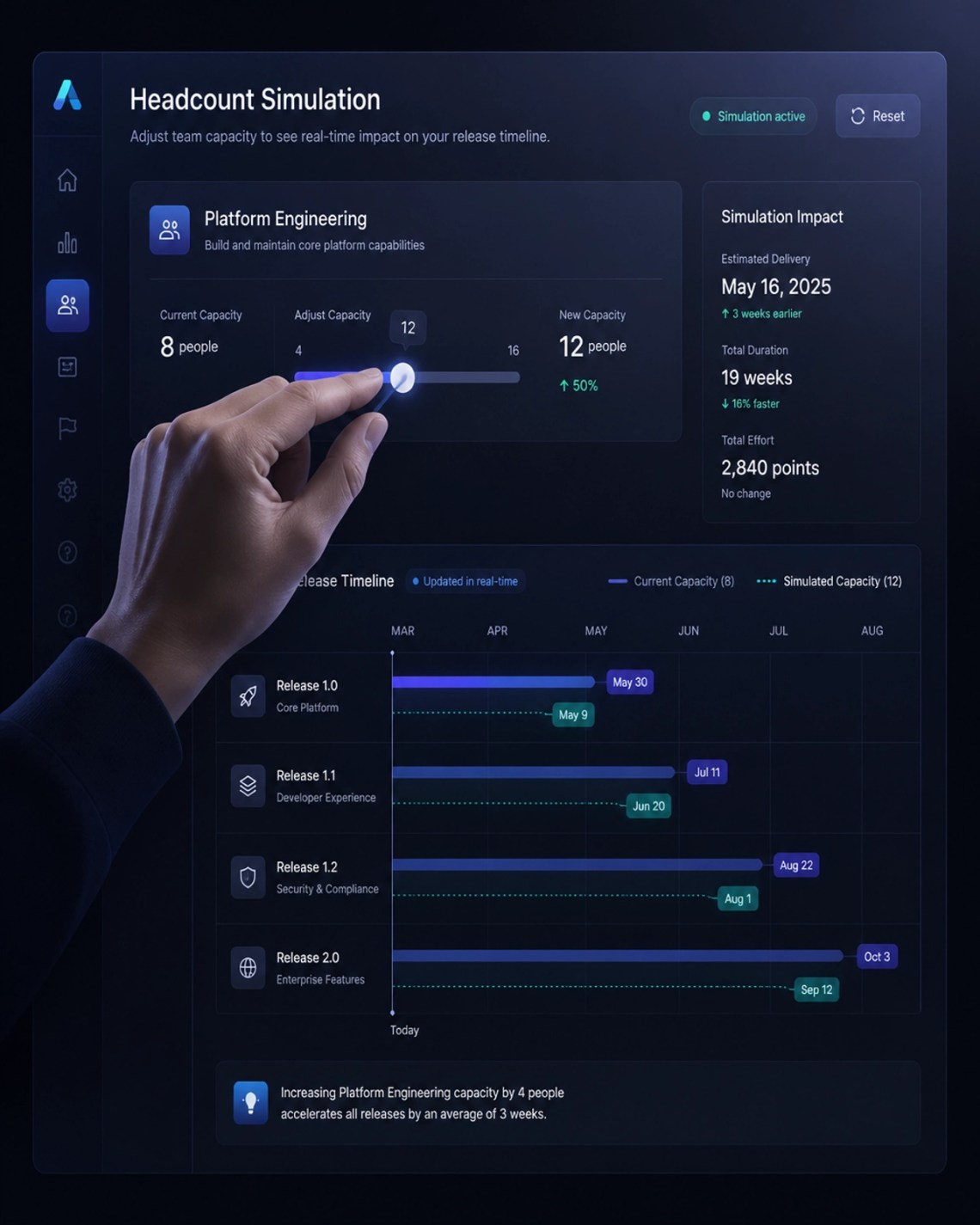
This is where it gets fun. "What if we hire two more backend devs in Q3?" or "What if the contract for our three specialists ends in October?" Instead of guessing, you should be able to run a simulation. Headcount changes shouldn't just be a note in a HR folder; they should be a slider on your release plan.

Active Planning vs. Passive Reporting
Remember Grasshopper, the goal of Agile isn't just to work; it's to deliver value predictably. Passive reporting waits for things to go wrong and then explains why. Active planning predicts the bottleneck before you hit it.
With our tools, like Scrum Agile Sprint planning with Capacity Planning, we empower teams to see their true capacity before the sprint starts. By seeing past velocity, current sprint points, and planned capacity in one view, you can finally say "No" to over-commitment with the confidence of someone who actually has the data.
Simulating the "What If": The Secret Sauce of Success
The most powerful part of capacity-aware forecasting isn't just seeing the current state; it’s simulating the future.
Efficiency-obsessed workaholics rejoice! You can now sit in your late-night sprint planning sessions (we've all been there) and play with variables. If we move this Epic to Sprint 4, does it fit with the upcoming holiday schedule? If we increase the capacity of Team A by 20%, does the release date pull in?
This isn't just math; it's strategic empowerment. It allows Product Managers to have honest conversations with stakeholders. Instead of saying "We'll try our best," you can say "Based on our true capacity: accounting for known holidays and scheduled PTO: this is the mathematically probable delivery date."
Why Divim? Because Enterprise Planning Shouldn't Be Hard
At Divim, we believe that Jira is the engine, but your teams are the fuel. Our apps, including Release Planning for Jira Cloud, are built to provide the visibility that large organizations desperately need. We’ve focused on creating a simple, intuitive interface that extends the Jira backlog you already know.
Whether you're using our Enterprise Sprint Automation to handle PI planning across dozens of teams or using our Agile Flow Metrics to hunt down productivity bottlenecks, our mission is the same: Clarity.
We all need clarity. Without it, you're just driving a fast car with a dirty windshield.
The Bottom Line
Capacity-aware forecasting isn't just a "nice to have" for modern agile teams: it’s a survival mechanism. In an era of remote, distributed, and highly specialized teams, you can't afford to plan based on wishful thinking.
By blending PTO, holidays, and headcount into your simulations, you aren't just making a plan; you’re building a commitment you can actually keep. And isn't that what we all want? To stop making excuses and start delivering?
Head today to the Atlassian Marketplace and try our apps for free. Let's make your next release the most predictable one yet.
Ready to stop guessing?
Explore our full suite of Agile project management tools or contact our team to see how we can help you scale your agile practices with confidence.
© 2026 : Divim, Inc. Digital Visual Management Systems and Consulting, Inc.
{“@type”:”BlogPosting”,”image”:”https://cdn.marblism.com/hkI9sr0U0TU.webp”,”author”:{“name”:”Divim, Inc.”,”@type”:”Organization”},”@context”:”https://schema.org”,”headline”:”Capacity-Aware Forecasting: Planning with Reality, Not Wishful Thinking”,”publisher”:{“logo”:{“url”:”https://www.divim.io/wp-content/uploads/2022/04/D_no_backround-1.png”,”@type”:”ImageObject”},”name”:”Divim”,”@type”:”Organization”},”articleBody”:”Capacity-aware forecasting is about making promises that match what your teams can actually deliver… (full content truncated for JSON length)”,”description”:”Learn how to move beyond static reporting to active, capacity-based planning in Jira Cloud. Discover how blending PTO, holidays, and headcount simulations can create a predictable agile roadmap.”,”datePublished”:”2026-05-19″}